
This site is a first draft following Bruce Chatwin and his controversial Book.
I read this book when published and have finally arrived at my destination for good, when I met Maria Ines here at the Gold Coast in 2004.
Looking back on my life and my career. Read more about Lehrerleben.
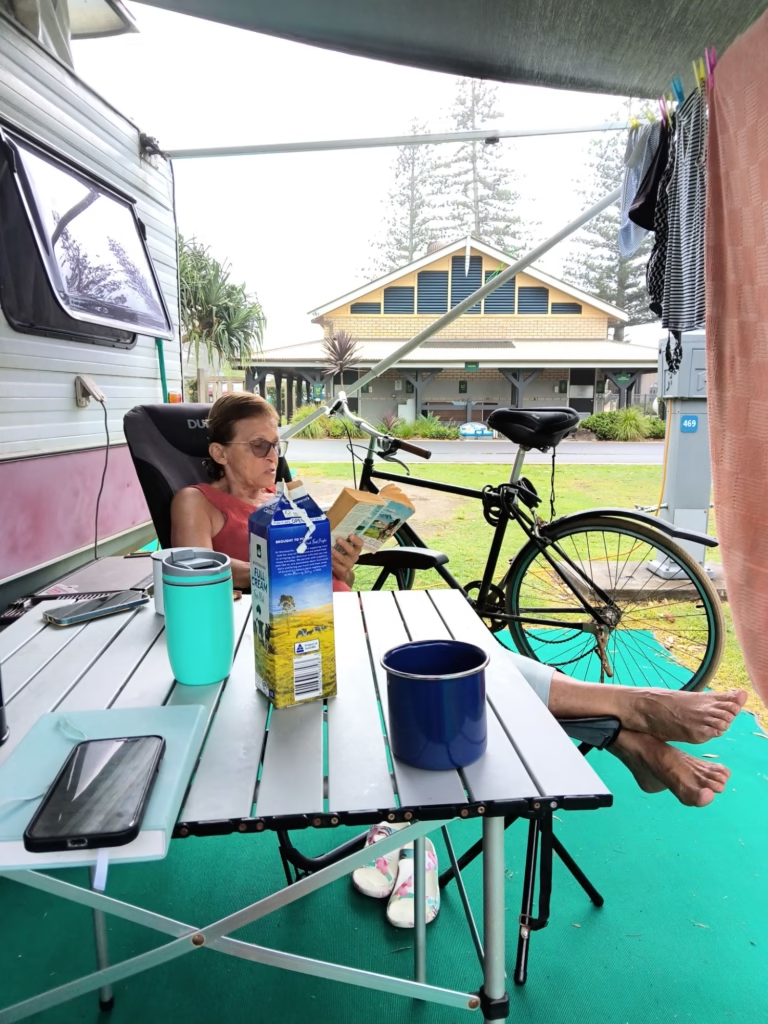
Peter H Bloecker lives, reads and writes at the Gold Coast in Queensland since he retired in Dannenberg / Elbe from the active school services in Aug 2015.

About me
My Bio is on my Blogs on Higher Education.

TITLE: Dots, Lines, Songs — On the Wisdom of Folk Knowledge and Songlines
SLUG: dots-lines-songs-folk-knowledge-songlines
EXCERPT: The dot painting is not decoration. It is encryption — and what it encodes is a question modernity has not yet found the honesty to answer.
CATEGORY: Philosophie & Gesellschaft
TAGS: bloeckerblog, english, songlines, aboriginal knowledge, folk wisdom, epistemology, benjamin, rosa resonanz
LANGUAGE: EN
There is a moment in looking at a Western Desert painting when the eye stops trying to decode what it sees and begins instead to feel the weight of what it cannot see. The dots, thousands of them, patient, precise, are not decoration. They are encryption. Sacred knowledge encoded for the initiated, withheld from the uninitiated, present in plain sight as a field of points that the Western eye reads as texture. The dot is the oldest B-Field in visual art: simultaneously revealing and concealing, its meaning alive in the gap between what is shown and what is known.
I have been thinking about this for a long time without quite knowing I was thinking about it.
I.
The songline is not a map. That formulation, however often repeated, is already a Western reduction, the projection of a cartographic epistemology onto a knowledge system that predates and exceeds it. The songline is a navigational instrument, yes, but also a legal document, a cosmological map, a musical score, an ecological record, and a relational ethic, simultaneously, indivisibly. The Western analytical move is to separate these categories. Physics here. Law there. Music somewhere else. The separation is not clarification. It is amputation.
Bruce Chatwin understood enough to write beautifully about songlines and not quite enough to avoid romanticising them. What he caught, and it matters, is that the song and the land are not two things in relation. They are one thing. To sing the songline is to walk the country. To walk the country is to sing it into continued existence. The knowledge is not stored somewhere and then applied to the territory. The knowledge is the territory, enacted in the body, transmitted mouth to ear across sixty thousand years.
Sixty thousand years. I write that and feel the number fail to register properly in a brain formed by European history, which considers two thousand years a long time and five hundred years recent.
II.
Folk wisdom operates by the same structural logic, though in less visible form. The proverb is not a simplification of complex truth. It is a compression, a dialectical image in Walter Benjamin’s sense: past and present in sudden constellation, the shock of recognition that arrives not through argument but through the body’s yes. The farmer who reads weather in the behaviour of cattle is not being pre-scientific. He is operating a knowledge system of considerable precision, one that took generations to build and can be destroyed in a generation by the withdrawal of the conditions, time, attention, continuity, that sustain it.
What is lost is not superstition. What is lost is a particular quality of attention: patient, embodied, intergenerational, calibrated to the specific rather than the universal. The scientific method, for all its extraordinary power, produces knowledge that travels, that can be extracted from its context of origin and applied elsewhere. Folk knowledge and songlines produce knowledge that does not travel. That is not a deficiency. It is the form the knowledge takes.
The distinction matters because we are living through the accelerating destruction of knowledge that does not travel, in the name of knowledge that does.
III.
Hartmut Rosa speaks of resonance, the vibrating relationship between self and world that modernity systematically severs in its drive toward control and availability. The songline is resonance as a cultural technology: a system designed not to master the land but to remain in responsive relationship with it. The dot painting is resonance made visible, the self distributed across the field, present at every point, centred nowhere.
There is something here that Adorno’s negative dialectics reaches toward from the opposite direction: the refusal of identity-thinking, the insistence on what does not fit the concept, the remainder that survives every act of systematic comprehension. The songline cannot be comprehended. It can only be walked.
I think about this when I swim at Burleigh in the morning and the water does what it does regardless of what I call it.
IV.
The deeper question, the one that does not resolve, is this: we know this. The epistemological validity of oral tradition, embodied knowledge, intergenerational transmission is not in serious dispute. The neuroscience supports it. The ecology supports it. The plain evidence of sixty thousand years of successful human habitation of this continent supports it.
And yet the knowledge systems we fund, institutionalise, credential, and transmit are precisely those that travel, that can be extracted from their conditions, archived, published, cited. The university is an extraordinary machine for producing portable knowledge and an almost perfect machine for destroying knowledge that cannot be made portable.
This is not ignorance. It is a structural preference built into the epistemological architecture of modernity. Chomsky would call it a filter operating at deep structure level, beneath the surface commitments to diversity, inclusion, and the value of Indigenous knowledge that any contemporary university will produce on request.
The dot painting sits in the gallery. The songline does not.
The water at Tallebudgera Creek has a name older than any word I know. This morning I could not recall it. I swam anyway.
Follow my Blogs on Higher Education.
Pls respect Copyright and Tm.
Written at the Gold Coast in Queensland, Australia
Fri 5 Jun 2026
Published by Author
You must be logged in to post a comment.